We write this final chapter in December of 2024 eighteen months after the end of our year wandering around France —two vagabonds trying to improve their French. Our failure to wrap up the loose ends weighs on us and drives us to do our best to reconstruct the last few weeks of May and the first week in June, 2023.
Only about three weeks remained of our year-long France adventure and by going east — to the Grand-Est and into the Champagne region, Alsace-Lorraine along the eastern border, and the mountains and plains of the Vosges — we will have satisfied our urge to visit every corner. We were grateful that the journey on the fast train from Paris to Rheims (“Reims” in French) is perfectly timed to allow for a café au lait and a buttery croissant en route. Upon arriving in the capital of the Champagne region, we claimed our rented car and began to check off the three sights that we most wanted to visit.
That was my reaction when Renie returned from attending Sunday Mass in Paris at Saint Pierre de Gros-Caillou in August of last year. As he spoke, he handed me the bulletin announcing a trip to the Holy Land planned by the parish and scheduled to depart from Paris in April, 2023.
Sharing what you love with someone you care about doubles the joy, so we were delighted when Presley and Jo Melton arrived in Nice to join our adventure. Diane pried herself away from her girls and their families in Kansas City after having enjoyed a wonderful Easter together and attending the birth of granddaughter Magnolia Christine, baby sister to Leo and Charlie. She returned to France and to Nice the same day as the Meltons.
Renie, Presley, and Jo — friends for more than forty years — reunite in Nice.
The hills above Nice are dotted with medieval stone villages built on hills, perched on rocky outcrops, or balanced on the edge of the face of a cliff — strategically chosen defensive positions. Some lie in rocky ruins while others have been perfectly preserved or superbly restored.
When Diane went to Kansas City for the birth of her first granddaughter, I went back to Villefranche-Sur-Mer for another two weeks at l’Institut de Français. This is the language school that we attended for a month exactly one year ago in April.
View of Saint-Jean-Cap-Ferrat and rhe Mediterranean from the school.
After two handsome boys, Leo 6 and Charlie 5, Catherine and Jeff became the parents of a beautiful baby girl, Magnolia Christine, on March 31, Diane’s first granddaughter.
Although we intended to limit our travels to French-speaking countries, since after all we came with the goal to improve our hard-earned, French-speaking ability, we couldn’t resist a few deviations.
For forever and a day we’ve heard about Île de Ré, a small island off the Atlantic Coast loved by tourists and year-round residents. It is so popular with Parisiens that it is has been called the 21st Arrondisement. The population of the nineteen-mile-long isle soars from 17,650 to about 220,000 in summer when sunny days are long and faint breezes cool the many beautiful beaches of golden sand.
When we realized that it would only take an hour and a half to drive to the Île de Ré from Jarnac, we couldn’t resist the urge to explore, liking the idea that while many restaurants, bars, and shops would be shuttered in early March, the number of tourists would be few.
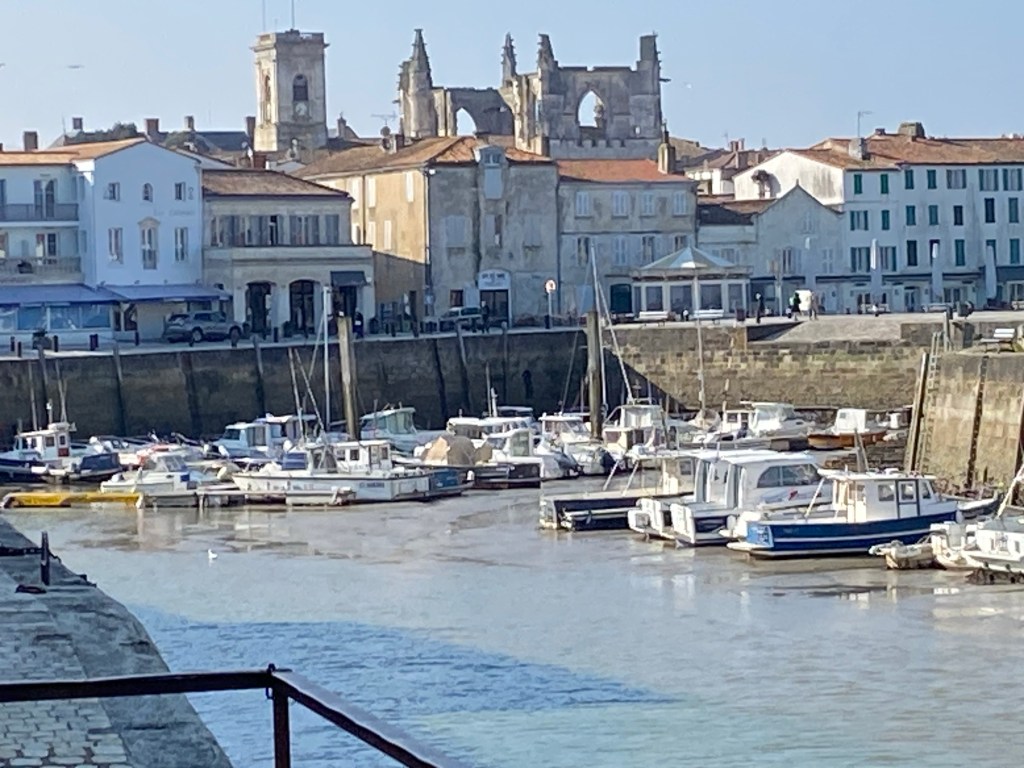
We chose to stay in Saint-Martin-de-Ré, the largest of ten coastal villages, where the weather gods smiled on us again with dazzling blue skies by day and a canopy of sparkling stars at night. We were well cared for by the excellent staff of Hôtel Le Galion during four lazy days reading, relaxing, and striving to get in at least 10,000 steps on almost deserted quays, old paved paths, and cobblestone streets.
Boats settle when the tide goes out leaving scores of mussels clinging to ancient walls in the inner harbor Continue reading →
Imagine that you receive an unexpected gift from a friend — one that you know will be nice because your friend is kind. Then, when you open the present, you discover a cache of riches so overwhelming that you are speechless.
Our friend, Jacqueline, resides in Kansas City six months of each year and in Jarnac, in southwestern France near where she was born, for the remainder. She lives across the hall from us in KC, where we bought an apartment to be closer to two of our daughters and their families. She remains French to the nines while she has embraced her American citizenship since she married her handsome American husband in 1957.
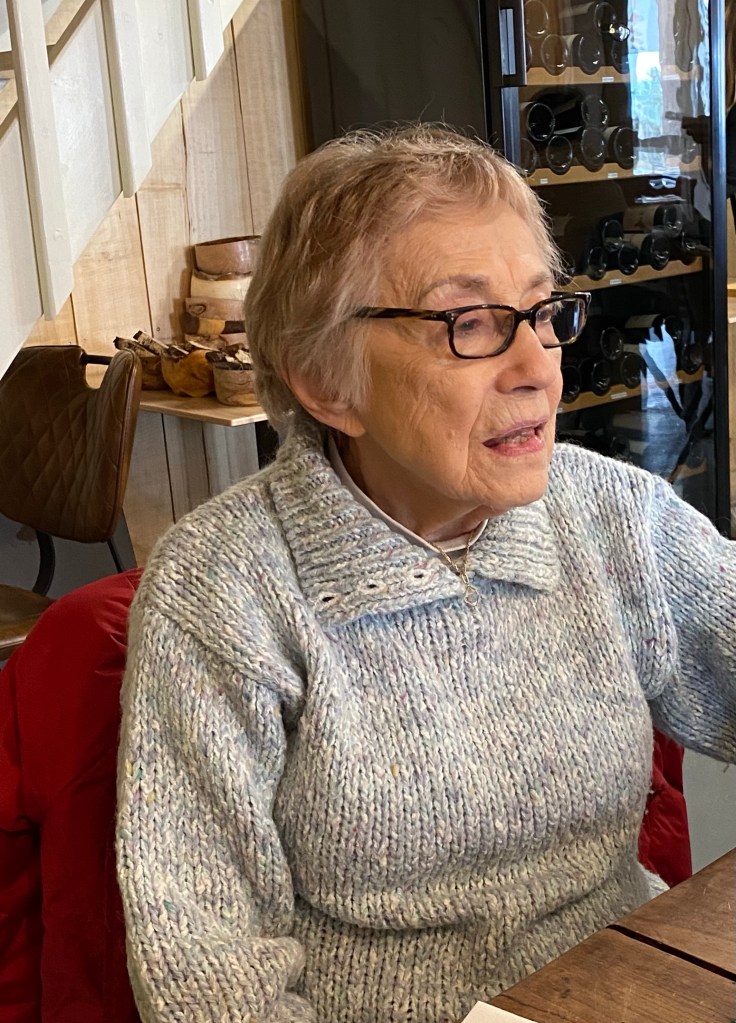
When Jacqueline learned that we planned to be in France for an extended period, she invited us to visit her in Jarnac and kindly insisted that we stay in her home. She is charming, energetic, bright, easygoing and ageless while living her troisième or maybe even quatrième age. We looked forward to learning about her way of life in France.
We flew into Bordeaux and drove north about an hour and a half to reach Jarnac and began to unwrap Jacqueline’s generous gift of hospitality. She welcomed us with a delicious dinner of duck confit, chestnuts, and red Bergerac.
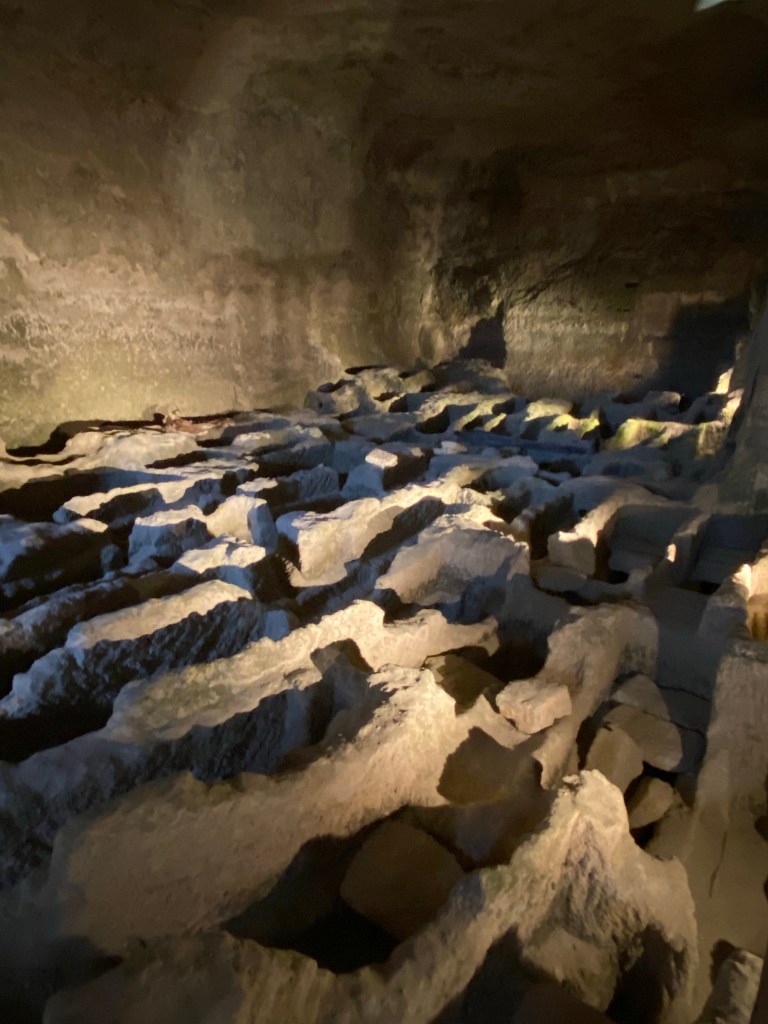
The beautiful river Charente flows through Jarnac and lends its name to the region. Aubeterre-sur-Dronne, officially designated one of “The Most Beautiful Villages in France” lies on the southern border of the Charente and the Dordogne regions. For more than 1,000 years, pilgrims have passed through this lovely village on their way to Santiago de Compostela in northwest Spain. Jacqueline guided us to Aubeterre so we could see the Church of St. Jean, the largest underground church in Europe, which was hewn by hand from a rock hillside during the 12th century — from the top down.
Massive Columns Rising 60 MetersLooking down to the stone reliquary carved from the hillside to house relics brought back from the First Crusade
All Cognac is made in the Charente. Vines are everywhere — in some places as far as the eye can see. It is still cold near the end of the season and winter wheat is practically the only green one sees. The old, short, gnarly grape-bearing stumps are almost black and the numerous shoots sprouting upward have been pruned by hand and reduced to only two before being espaliered along the supporting wires.
Jerome’s farm
Huge fields of old grapevines border those newly planted. Each newbie plant has a colored plastic sock or collar at its base to protect from predators. There might be hundreds or thousands of green or blue or orange or white socks in a field, their colors blurring as we speed by.
Pineau des Charente is a tasty fortified wine made by blending Cognac with either slightly fermented grape must or fresh grape juice before being aged in oak barrels. It is a treasure of the region but not well known around France and hardly at all in the rest of the world. To say it is delicious is an understatement.
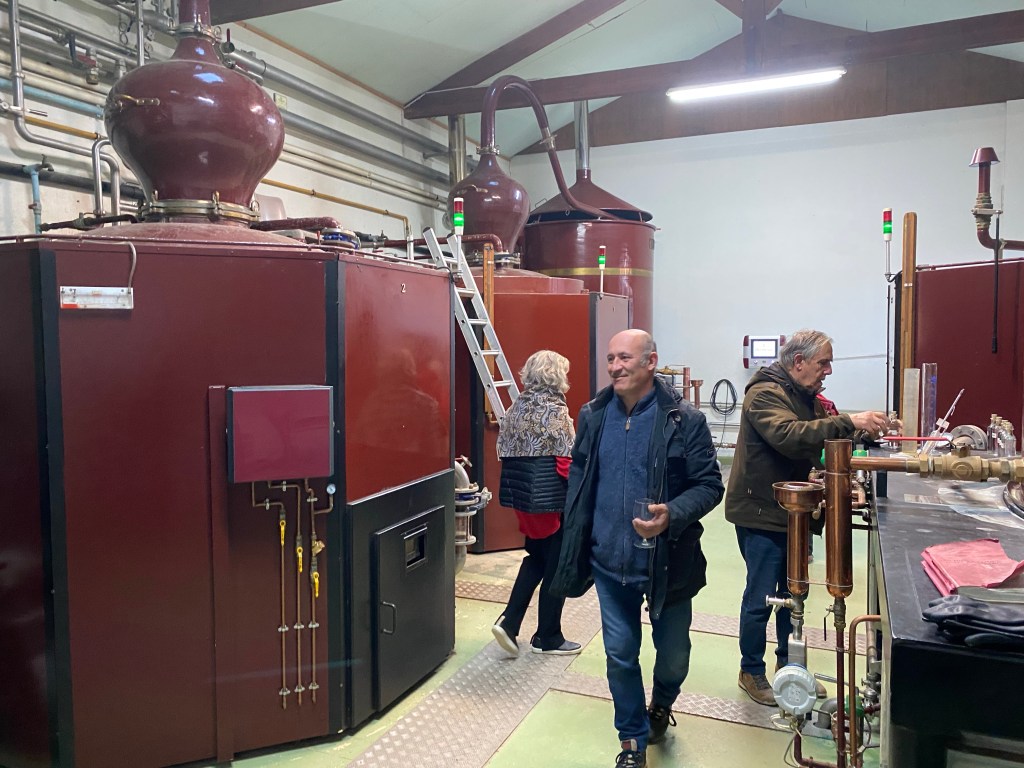
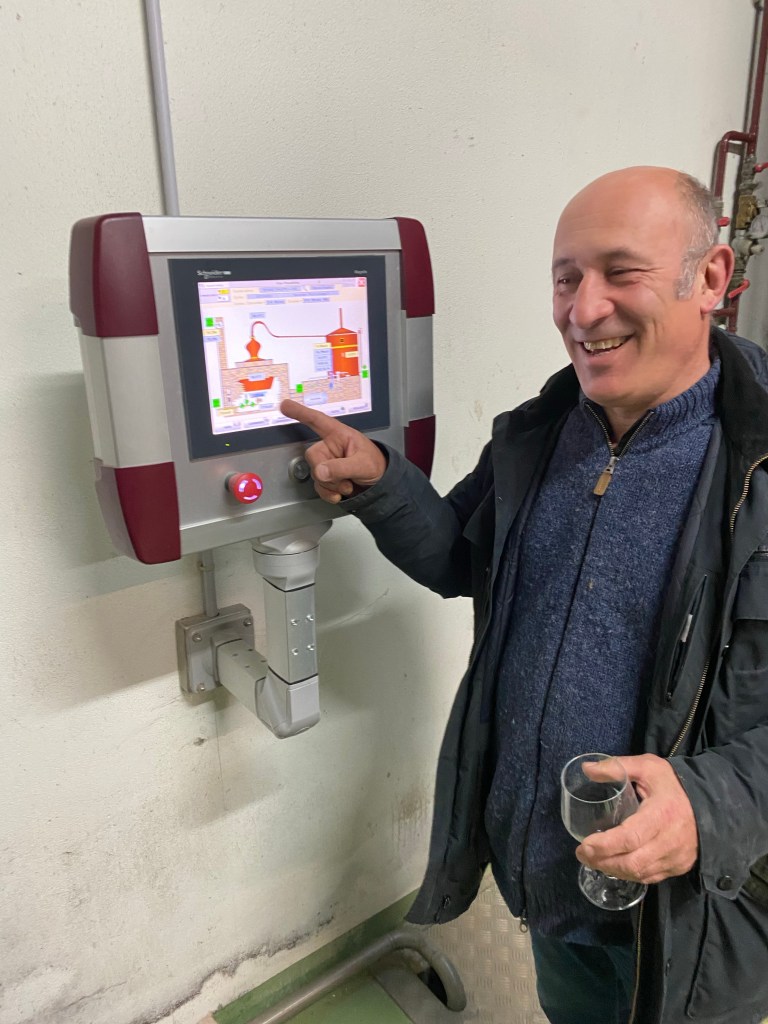
As Jacqueline’s visiting friends, we were warmly embraced by her family of cousins; Jannine, Jerome, Veronique, Justine, Charles, and Jean-Claude. Vintner Jerome not only continues the family business of growing grapes but also continually expands and modernizes the enterprise. Hennessey is an important customer and the majority of Jerome’s production of eau de vie forms the basis of its world-renowned Cognac.
We are captivated by our tour of Jerome’s operation in Sigogne.
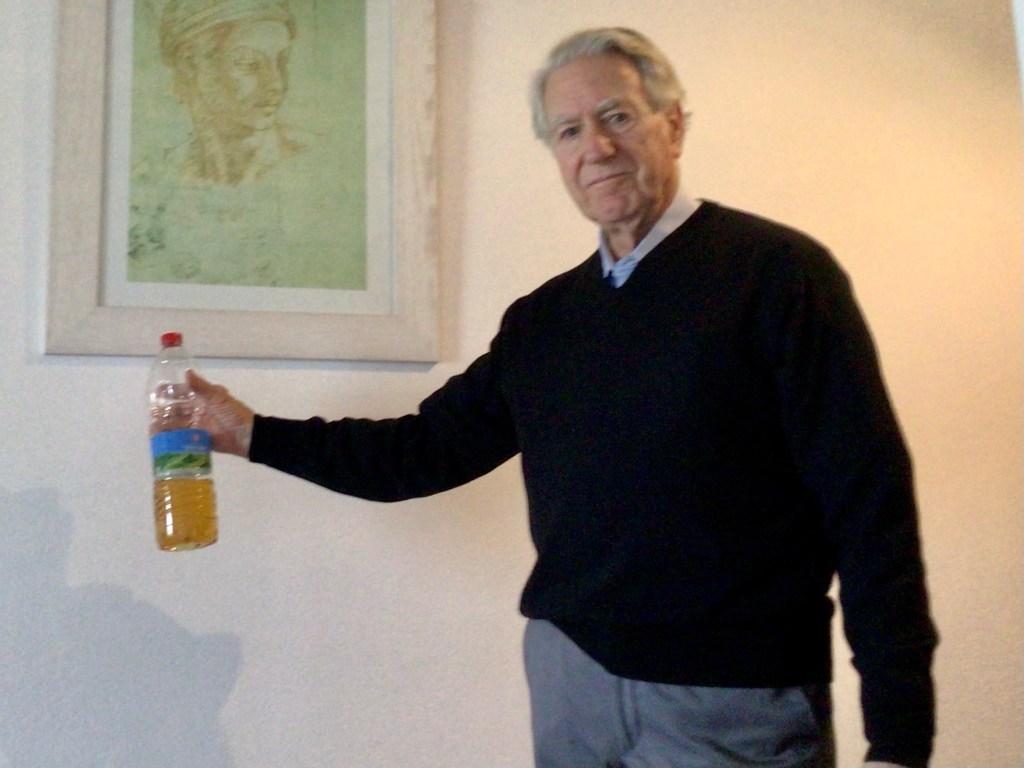
One of these days Jerome might market his pineau. In the meantime, we were the beneficiaries of a signature bottle packaged home style.
Just to be clear, when Jerome gave it to us the bottle was full
Can you believe it? Jerome took us truffle hunting! In the forest of oaks that he planted twenty years ago. His gorgeous well-groomed black lab Muscat led the way demonstrating his acquired expertise at nosing this “black gold” from the earth.
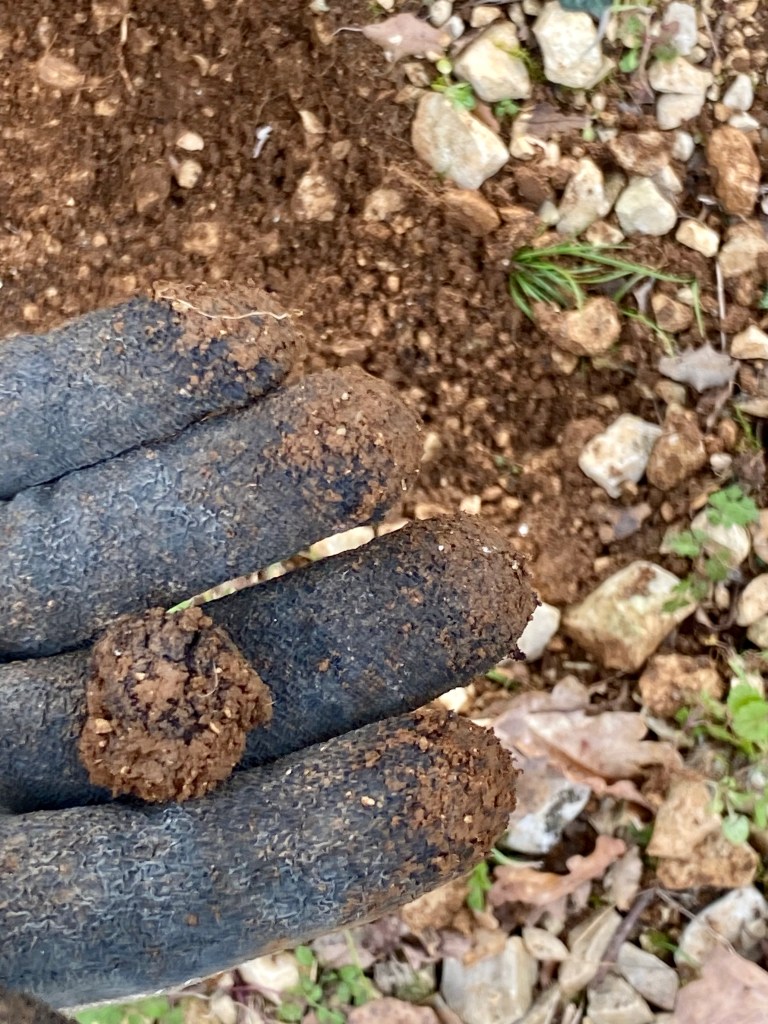
It is the end of a very dry season but after Muscat pawed the dirt at the base of trees, Jerome confirmed the finds by sniffing the soil then sifting the dirt through his gloved fingers to reveal the prized fungus. Muscat seemed satisfied with his reward for each success — a tiny morsel of cheese.
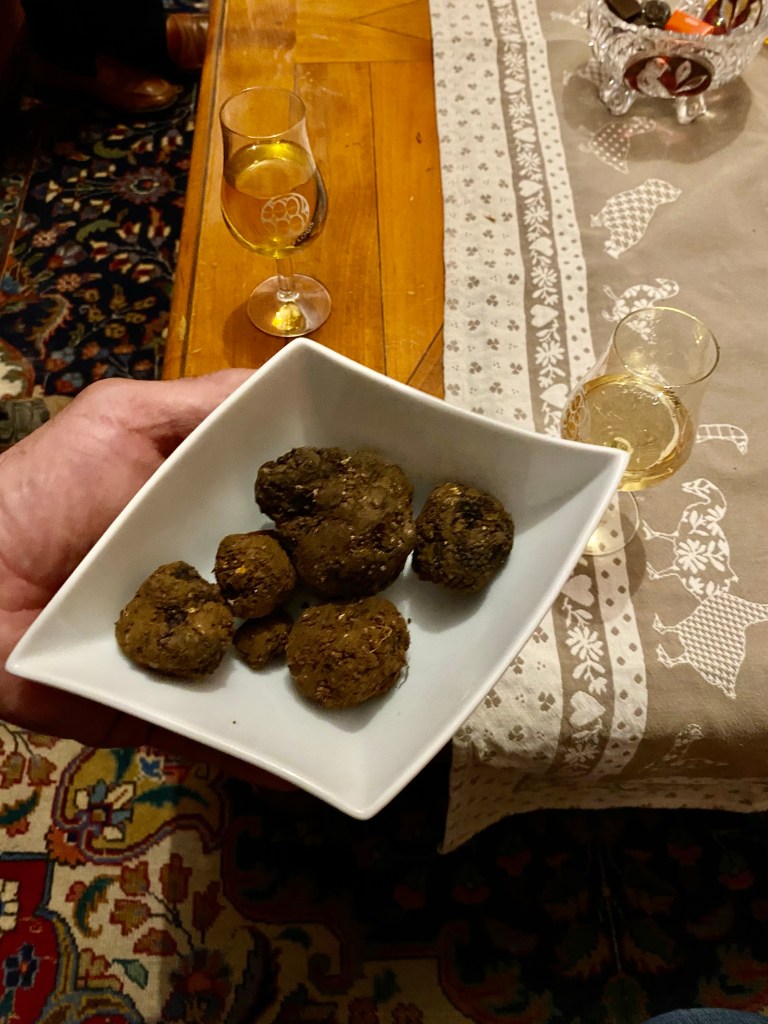
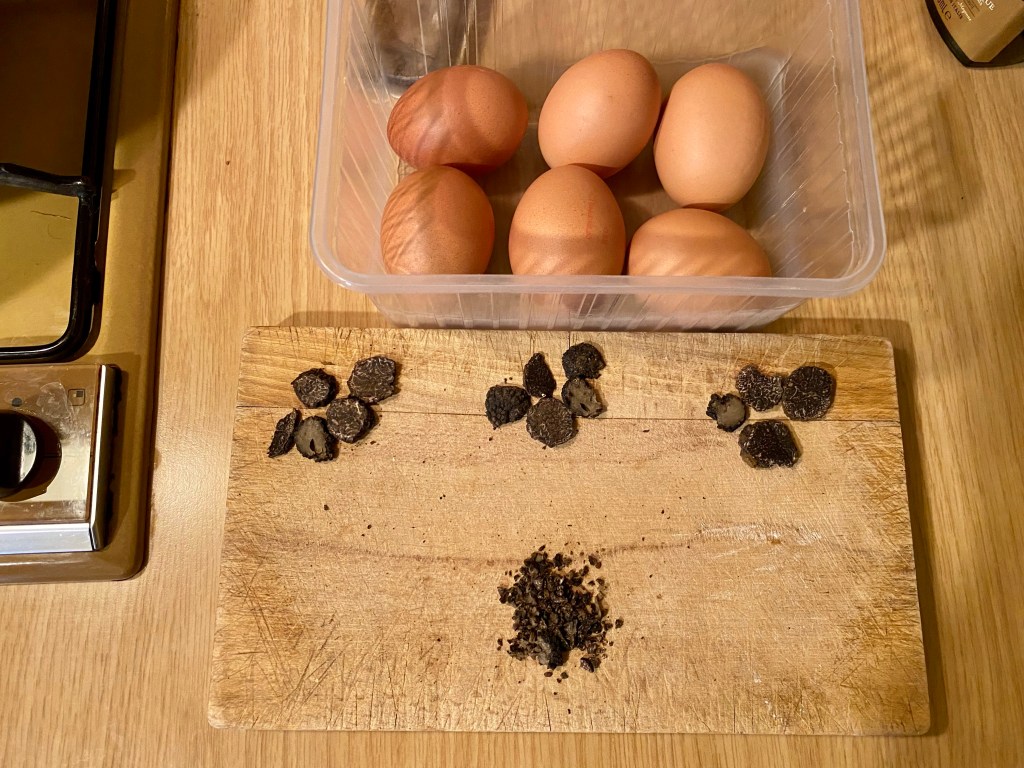
We were elated with Jerome’s generous gift of truffles.
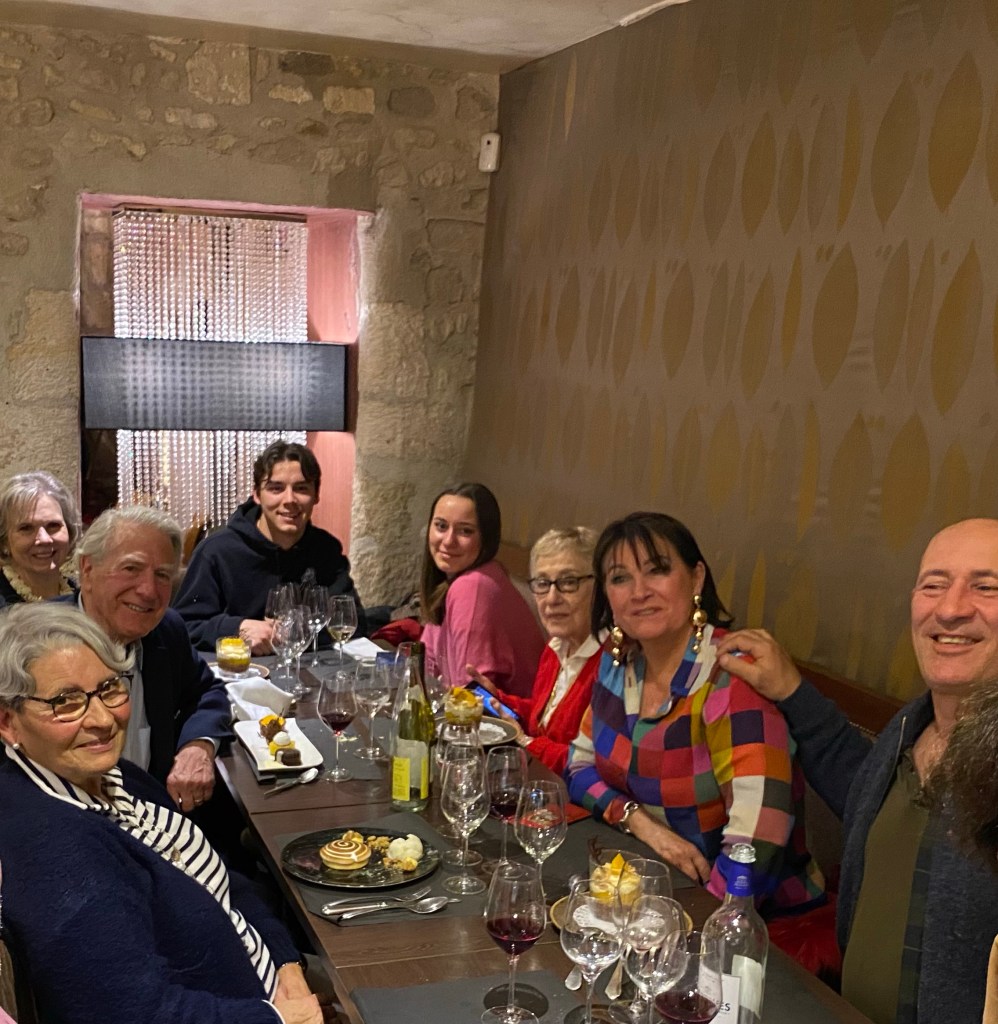
Everyone agrees that 1944 was an excellent year — that of our births and of Jerome’s mother Jannine. Her birthday celebratory dinner was a blast and we especially enjoyed getting to know her twin grandchildren Justine and Charles.
Jannine, Renie, Diane, Charles, Justine, Jacqueline, Veronique, and Jerome
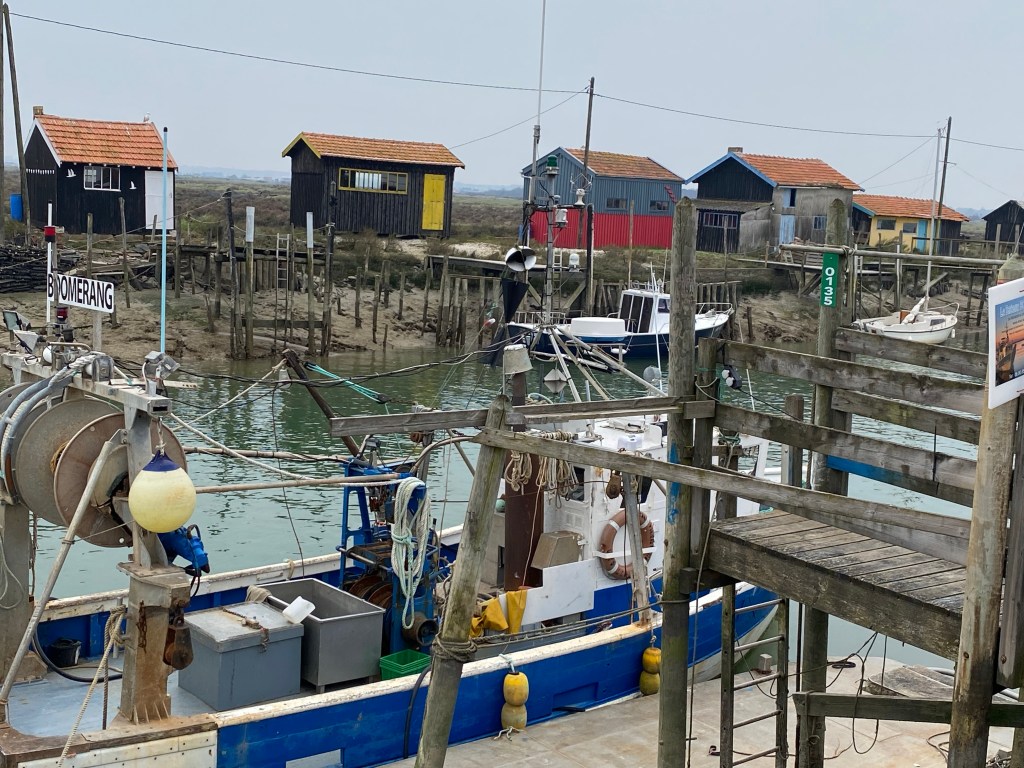
Next was a full day of touring the near western seaboard. The string of charming villages are edged with long beaches of golden sand devoid of visitors except for a few surfers who brave the cold. Here, too, where weathered shacks line the quay, oysters are king.
After another memorable meal, enjoyed near the edge of the Bay of Biscay, we piled again into Jerome’s car to continue to Royan for a look at two apartments being converted to gites and their vacation home which is undergoing a transformation.
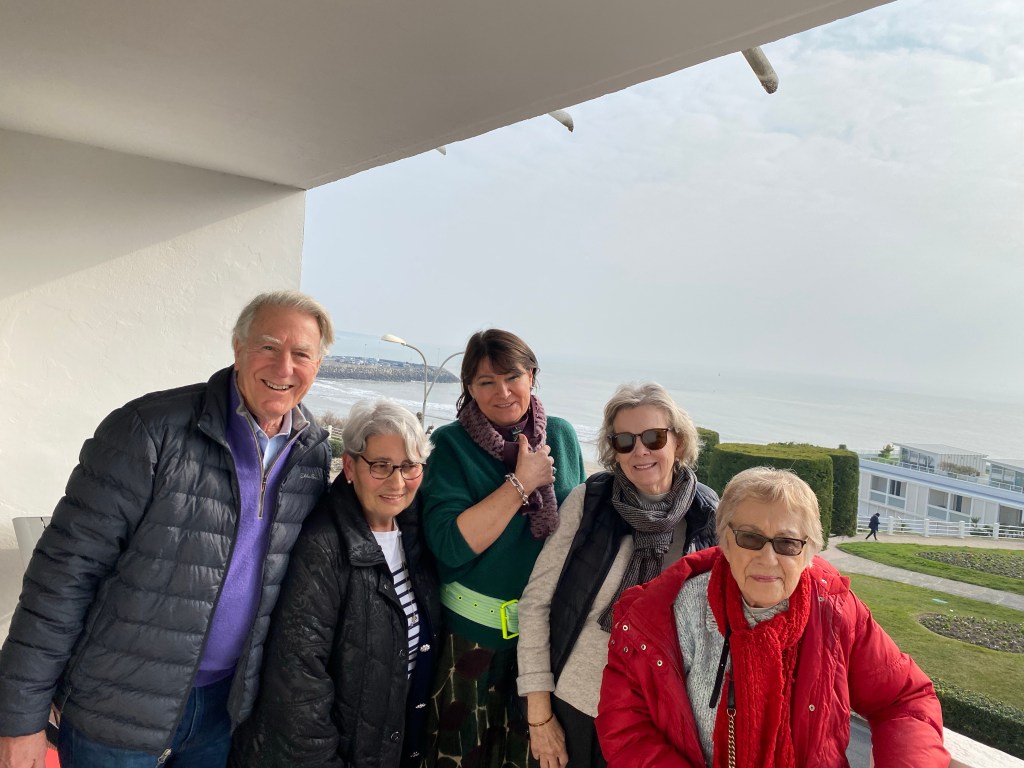
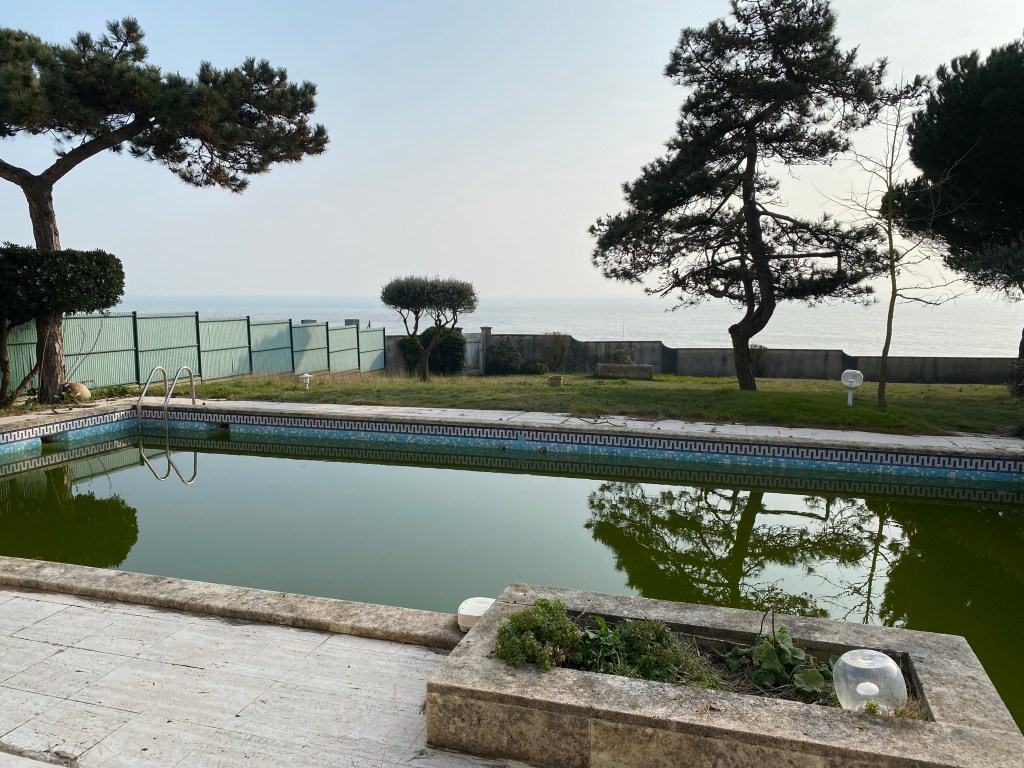
More yummy oysters: On the balcony of their gite in Royan: View of the Atlantic Ocean from the vacation home terrace.
After champagne toasts, Jerome delivers us to our car in Sigogne, and we return to our Jarnac home. The next morning, as we say goodbye to Jacqueline, she encourages us to remember her belief that everything happens for a reason. While we don’t quite know the reason, we do realize that she has given us a magnificent gift. Not only of these three days of wonder, but of her friendship — which we cherish.
It is time for us to pause and answer the call of family and friends who beckon us home for the holidays. But before we go, we want to share a little about the ground we covered since leaving Belgium.
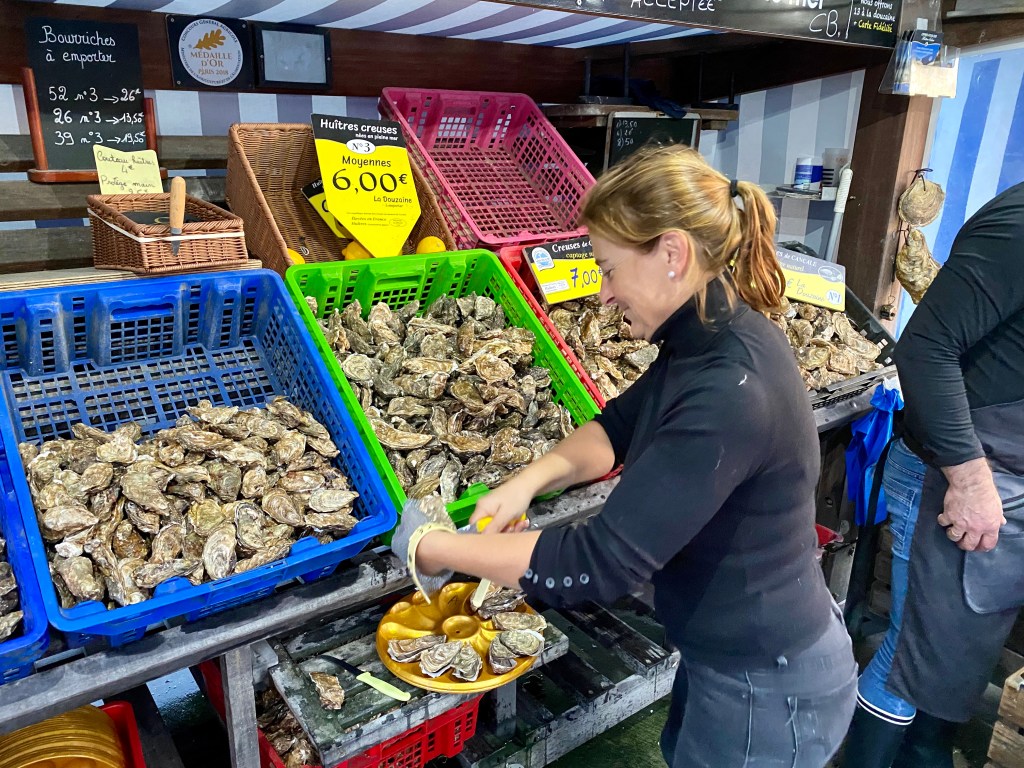
Cheerful vendor shucks and serves Cancale oysters
We worked our way westerly toward the Brittany coast and hunkered down for two nights in a chambre d’hôte above the Cancale harbor. Cancale is famous around the world for its succulent oysters so it was easy for us to go native and join the villagers in their evening ritual. At about 6 pm, we would pop down to the shacks at the water’s edge, make our selection of just-harvested mollusks, and carry the large filled plastic oyster plates garnished with half a lemon to the steps of the seaside amphitheater. Then we would buy a glass of white wine to complement our slurping of the briny creatures from their shells before pitching the empties to the rocky beach below where seagulls feast on the leavings.
Yes, the Fatherland because Renie’s father was born near Antwerp, Belgium in 1905. He was in his 30’s when he immigrated to the US, met Renie’s mother in NYC, married at The Little Church Around the Corner, then relocated to Arkansas when WWII started.
Nighttime in Ghent along the canal
Although French was Renie’s dad’s native language, he rarely spoke a word of it wanting, like so many others of the time, to blend in as a proud American. Eventually, but not until after Mr. Bressinck’s death, Renie’s genetic predisposition won out and speaking French well became a passion.











 Travel in Le Troisième Âge