
Since leaving Switzerland on August 30 and arriving in Flanders Fields on October 9 (See entry dated Oct. 14), the time we spent in interesting places and with precious family and dear friends trumped any efforts to stay in touch. The details of our stays in 13 different hotels and gites in 40 days would exhaust even our most ardent followers, but by moving around so often, we were able to sate our curiosity about certain new places and satisfy our desire to revisit others.
The Jura, a mountainous region stretching from Burgundy on the west to Switzerland on the east, is renowned for its cheese, wine, and beautiful mountains and meadows. The Jurassic period is named for this mountain range. It is home to some of the prettiest villages including Saint-Claude, the global capital of pipes fashioned from the woody root of a shrub-like plant.
Would anyone be surprised that Renie flagged the world capital of briar-wood pipes as a do-not-miss — a place where even the trash cans resemble pipes? Few things please him more than a stroll out-of-doors preceded by the ritual of packing his wooden Savinelli pipe with the special blend of tobaccos that Greg at the pipe and tobacco shop in LR concocts for him. In this regard, he is a carbon copy of his pipe-smoking dad.


Next we were drawn to revisit the rural southwest department of Dordogne in the Perigord region. In our mind’s eye from long years ago, we can picture the way the quaint, timeworn villages line the meandering river while chateaux keep a lookout from on high.

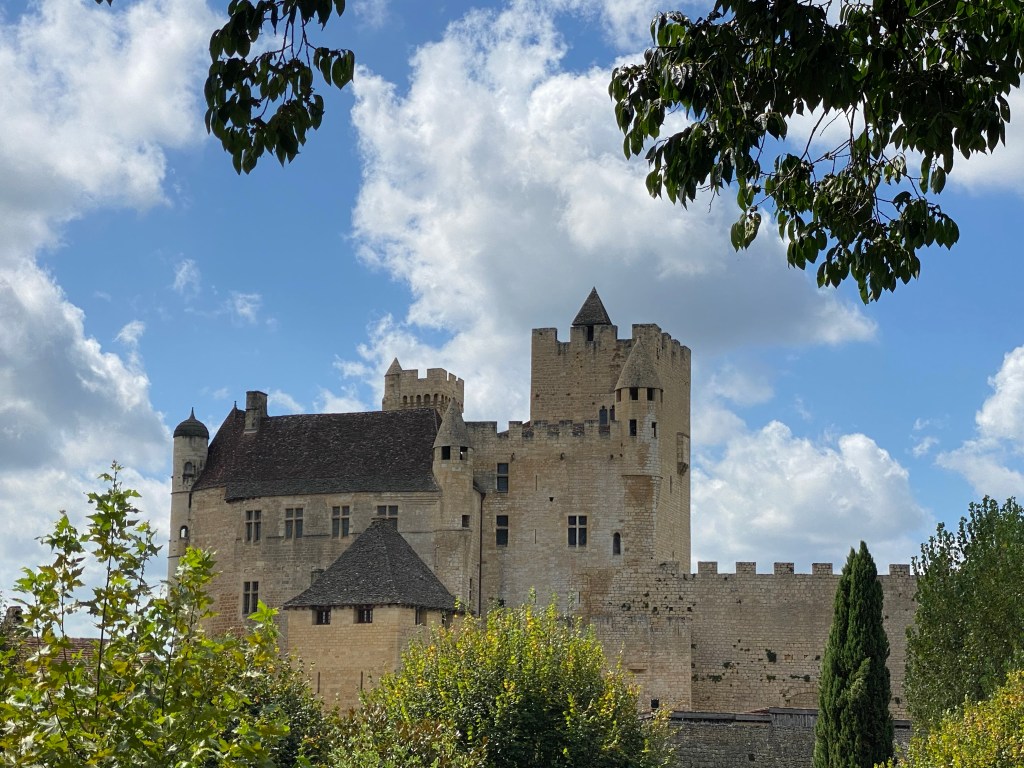
Richard the Lionheart claimed the then recently constructed 12th century fortress, Beynac, through his mother Eleanor of Aquitaine. The castle was an important stronghold strategically positioned above the river Dordogne which used to delineate the borders of France and England.
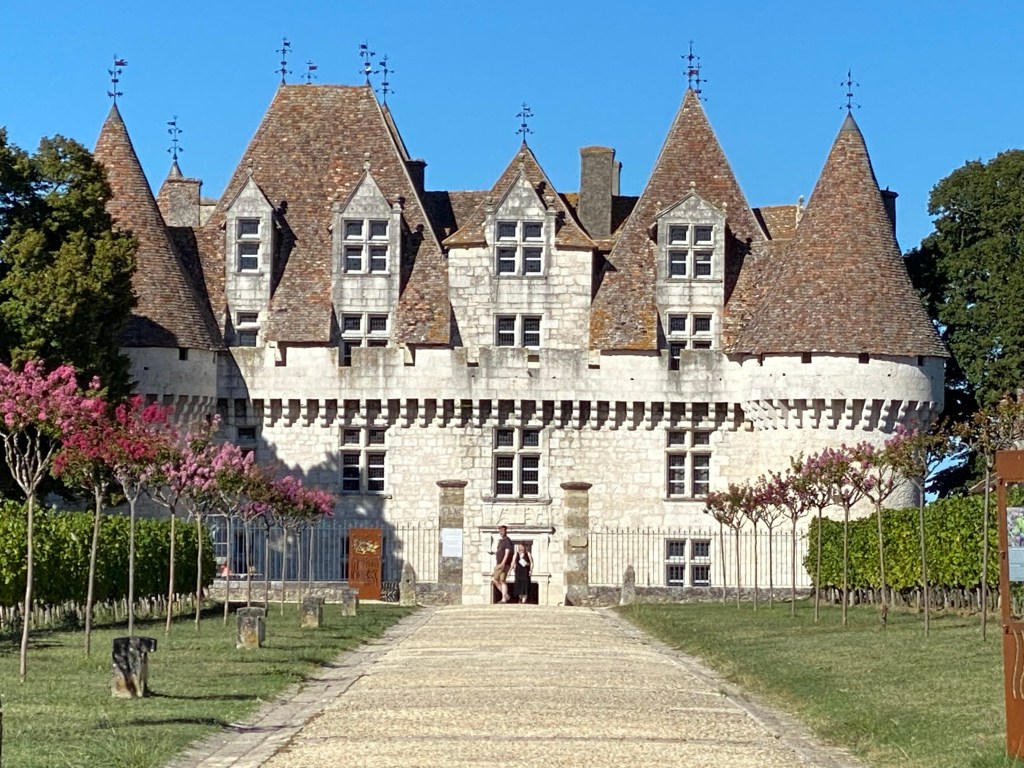
Vineyards reaching back to 11th century Benedictine monasteries still fuel the production of Monbazillac, a sweet wine and delicious accompaniment to foie gras.
The well-preserved medieval town, Sarlat, anchors the history of the Dordogne with 77 protected monuments from the 14th century. The town developed around a large Benedictine abbey, Saint Sacerdos, and due to its location inland from the river, miraculously escaped devastating Viking raids. Our walking tour took us up and over the ramparts and through the cobblestone streets leading past Renaissance era homes of golden stone with unequaled patina, ancient shops showcasing the work of artisans and craftsmen, and food markets with honking ducks and geese seeking to avoid the requisitioning of their livers for the production of foie gras, the region’s delicacy.
In contrast to the sophisticated architecture, bustle of life and tensions created by a legacy of warring over power and possessions, the Dordogne contains complexes of eerily silent caves with paintings of exceptional quality thought to be more than 15,000 years old. Though not the only decorated labyrinth in the region, Lascaux is the most famous.
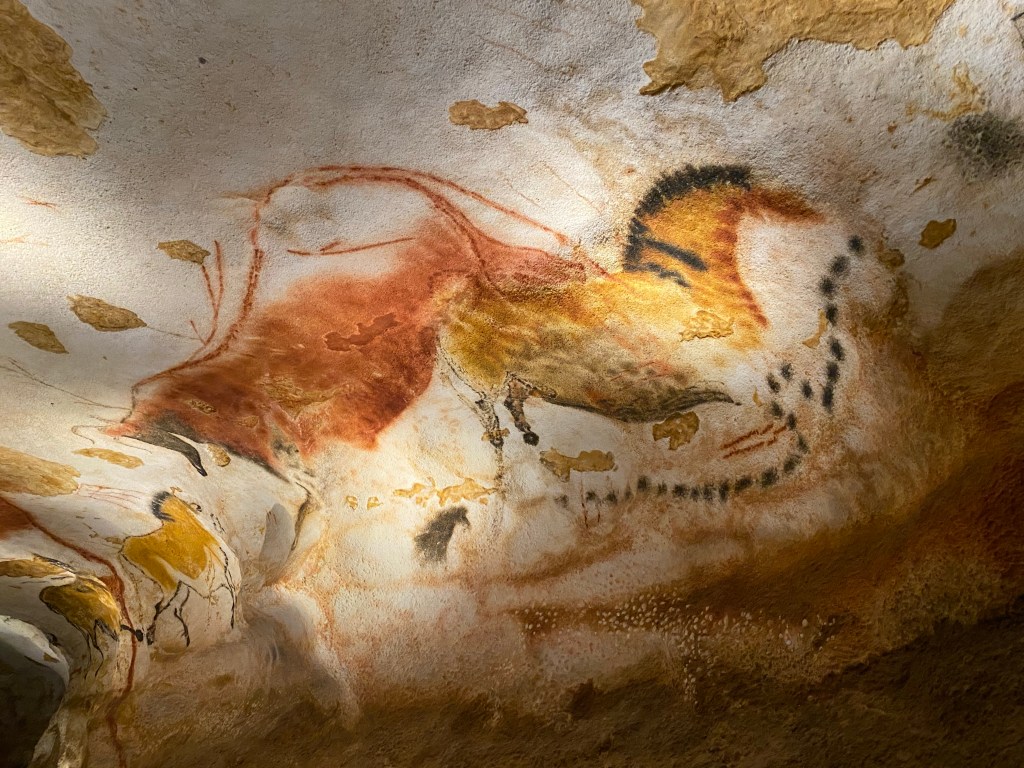
Due to the harsh effects on the paintings caused by too many visitors, Lascaux has been closed to the public since 1963, only 23 years after its discovery by a group of four boys. I was wary about bothering to visit the supposedly painstakingly-created replica, especially since I’ve seen a documentary where researchers showed the real thing and read the issue of National Geographic reproducing the cave paintings on its pages. But my skepticism was misplaced and I found myself filled with awe at the masterful reproduction and wonder at the civilization that produced the original 600 paintings and 1,500 engravings of birds, bison, deer, aurochs, and horses together with hundreds of patterns of dots and shapes that have never been deciphered.
At the end of our day seeing new things and reflecting on the old, we returned to our Dordogne home, La Borie des Proissans, to enjoy our final evening before moving on to Burgundy.
—Renie and Diane
 Travel in Le Troisième Âge
Awesome blog. Great photo of you guys. Love the story on the pipes. Did no know you smoked a pipe. I used to smoke a pipe and loved it. Like Bill Clinton, I did not inhale. LOL
Robin
LikeLike
OH….those caves!! I immediately had to go online and take a tour… Gail
>
LikeLike
Excellent as usual. When you finish your years in France have you considered visiting places on Italy’s west coast like Almafi? Probably spelled wrong.
You are really not missing anything in the USA with all of the political infighting so I would probably stay in France and Europe.
When are you planning on coming back?
Continue to have a good time and continue the updates.
Glenn
LikeLike
Encore un merveilleux voyage dans un très vieux pays…..
Jacqueline
LikeLike
Another great blog, thanks!!! Who knew there was a pipe capitol of the world!! Happy to know you’re both happy and well. Happy and safe travels. Love, Vicki
LikeLike
Lots of happy 🤣
LikeLike
Diane and Renie, Thanks so much for your latest chapter traveling thorough Jura and the Dordogne and the wonderfully quaint city of pipes! Fun to think of Renie in his element! And on to Burgyundy! You will be visitng Beaune, I am sure, where I once stayed at the charming Hotel de la Post, toured the famous Hospice de Beaune and sampled some of their divine wine. Autumn days in Arkanas– nice foliage and mild weather. All the best, Rem
LikeLike
Ah … your latest adventures, dear Cousins … fascinating about the cave paintings … and Richard and Eleanor ..
Continue your marvelous travels with new installments ..
Love you .. so good to hear your voice the other day, FC !!!!!
LikeLike
you are visiting an area I would LOVE to revisit. LOVED the pipe trashcan, how great was that! always fun to read about your adventures.
Love, Anne and Phil
LikeLike
You two seem to have enjoyed your trip to the Perigord region and the Dordogne River valley as much as Tony and I did when we were there a number of years ago. The expansive view from the fortress is truly spectacular in virtually every direction. We actually stayed in the town of Beynac on the main street about halfway up the hill (quite a climb but so worth it!) and had a delicious meal of foie gras and roast duck at a picturesque restaurant on the river. Your blog here brings back so many wonderful memories of our trip there and throughout southern France. As Rick Steves would say, “Keep on travelin’!
Cheers!
Paula (and Tony 2)
LikeLike