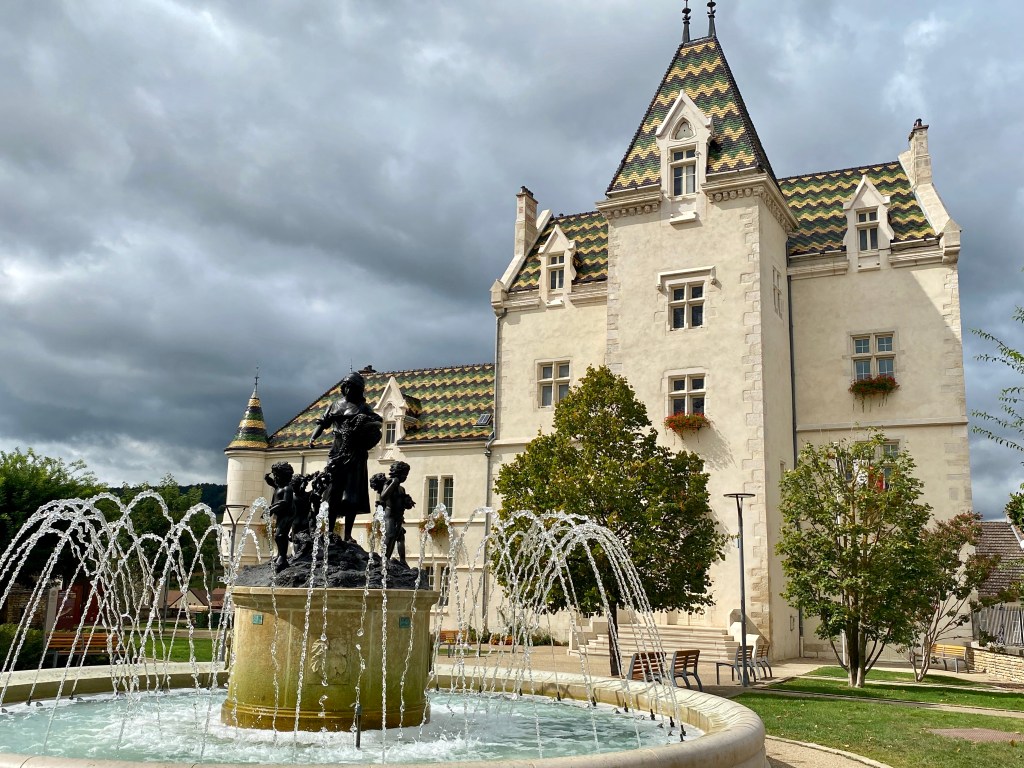
In France, locating a suitable gite to rent for a week or so is kind of like buying a pig in a poke. First we conduct an exhaustive search on the internet then plunge into the sea of choices and grab one. The guardian angel of “le troisième age” often looks after us and we usually end up with a great place. La Cour Vincent in Bligny-sur-Beaune was one of those and it came with a bonus — the gracious and elegant owners M. and Mme. Duréault.
When Renie’s brother Phillip and our sister-in-law Judy chose Burgundy as the place they wanted to visit, we readily agreed knowing of its superb wines, world-famous cuisine, history of the powerful Burgundian dynasty, and place as the cradle of monasteries such as Cluny, Cîteaux, and Vézelay.
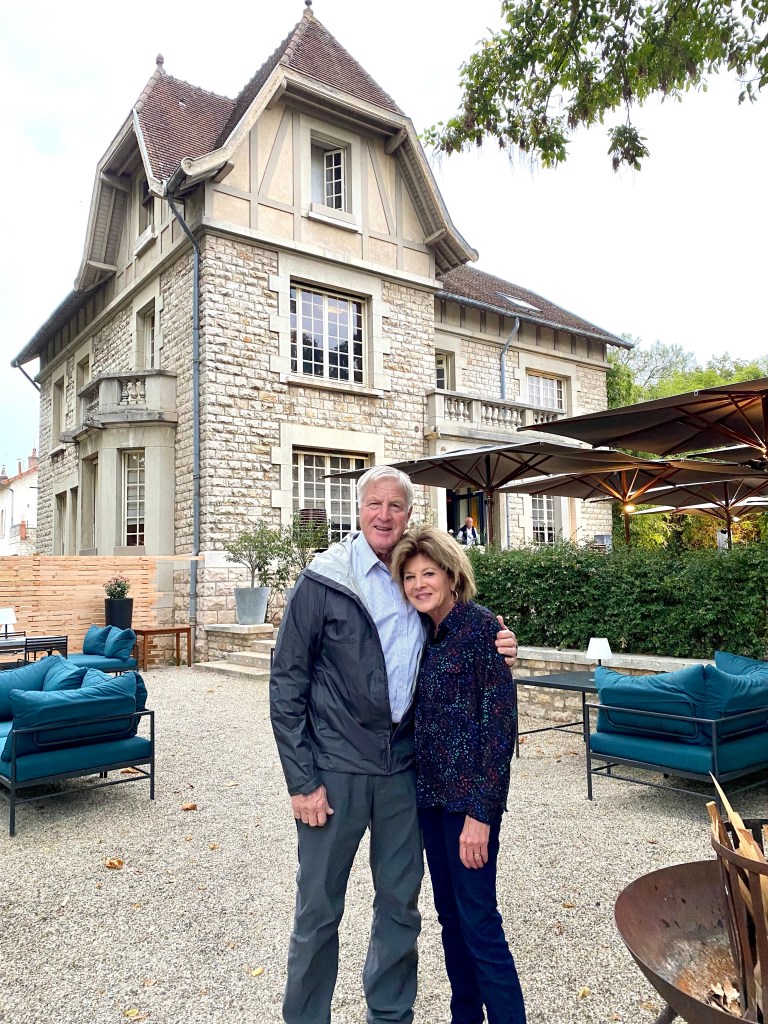
We spent our five days together exploring tiny wine villages and tasting excellent vintages including the Mercury Premier Cru produced by our hosts the Duréault family made too easily available to us in the wine cellar in our basement. We wandered through the halls and chambers of the immense Hospices de Beaune, a charity hospital for 500 years and now a museum of medicine and history. We hiked along the Burgundy Canal: some of us took bike rides. At the market, we forked over $42 for an already roasted chicken from Bresse, one of those world-famous fowls that probably tastes better when someone else cooks it — preferably a three-star chef. In other words, we had a wonderful time together, laughing lots and creating even more fond family memories.

The drive from our little village, Bligny-sur-Beaune, to Beaune itself takes only five minutes. Beaune is in eastern France in the Côte d’Or department and is a major center of wine production and business. It is considered the capital of Burgundy wines. Some of the most famous wines in the world are produced nearby including Meursault, Montrachet, Pommard, Corton-Charlemagne, Romanée-Conti, and Santenay.
The remarkable Hospices de Beaune with its roof of colorful polychrome tile contrasting with the austere facade endures as the iconic image of Beaune.

According to information provided by the museum, the Duke of Burgundy’s chancellor and his wife, in an attempt to atone for their sins and assure their places in heaven, founded and funded the Hospices de Beaune in 1443 as a charitable hospital for the poorest and most disadvantaged people. Vast numbers of the inhabitants in Beaune were destitute as a result of the pillaging and massacres that continued even after the treaty that ended the Hundred Years’ War. An outbreak of plague added to the misery. Those who needed care were treated both in body and spirit in this Catholic hospital beginning in the Middle Ages and continuing until 1971.
One could conclude that the chancellor had lots of transgressions to make up for because he created not only a healing hospital and spiritual sanctuary staffed by a religious order that he founded for the purpose, but also a monument to Flamboyant Gothic architecture. The interior was decorated by masters of painting, glassmaking, and woodworking. The Flemish master, Rogier Van der Weyden, created the magnificent altarpiece “The Last Judgment”. Maybe best of all, the benefactors donated enough of their wealth to ensure that this legacy could be sustained for generations.
Interestingly, a donation of a wine estate by a fellow nobleman in 1457 started the Hospices de Beaune vineyards. Donations continued over the years so that today, the foundation owns 60 hectares (about 150 acres) of prized grapes that make up 85% of the prestigious wines auctioned every year by Southby’s in Beaune – the largest and most famous wine charity auction in France and perhaps the world.
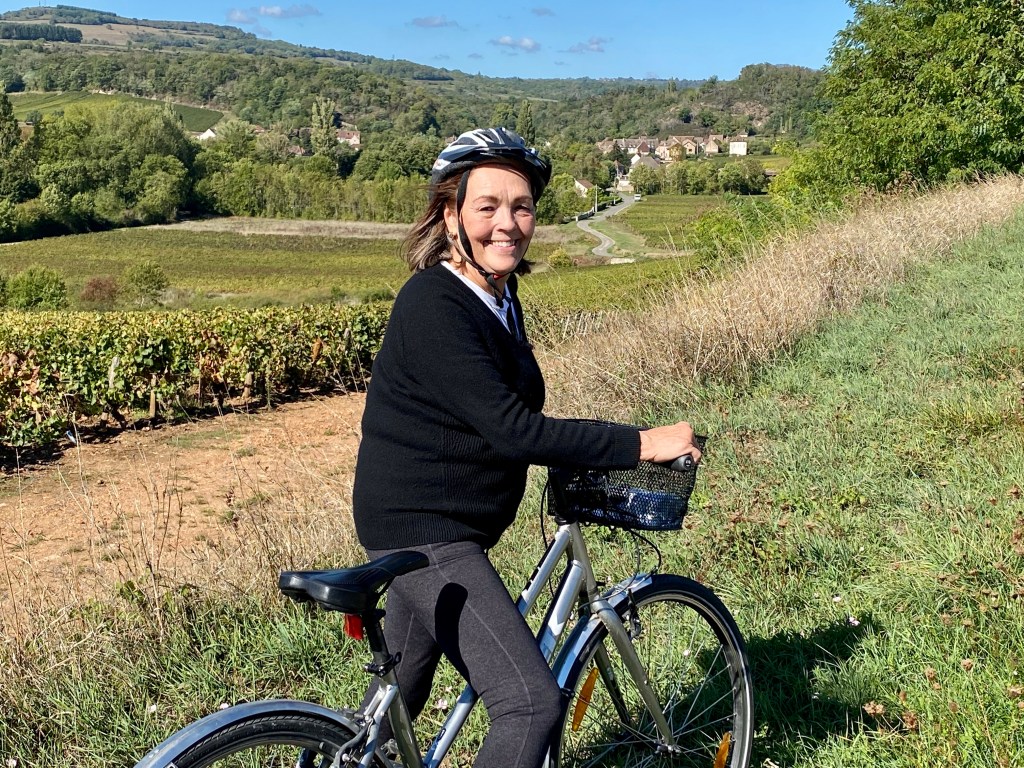
After seeing Phillip and Judy off on their next adventure — to the Loire Valley, Bayeux, and the D-Day beaches, we welcomed our friend, Jane Cudahy. When Diane moved to Kansas City in 1986, Jane befriended her and they have remained close ever since.
Our time together included good meals shared in the garden, an excellent bike ride, wine tastings, and exploring Dijon and multiple villages in the region. Discovering that the stores in Dijon had no mustard, largely due to the drought in Canada which is the primary source of France’s mustard seeds, was oddly funny. And the shops in quiet Flavigny, officially designated as of one of the prettiest villages in France, were devoid of the famous Flavigny mints that are produced in the abbey there and sold in every museum shop in France and distributed worldwide.
The film Chocolat was made in Flavigny and the building with the charming storefront where Juliet Binoche worked her magic is for sale. After we helped a struggling resident heave her heavy load of groceries up a steep stone stairway, she invited us in for tea on her charming porch overlooking an old and somewhat wild garden. The three of us were enthralled with her stories of being a Rotary exchange student in Seattle during the 50’s — an experience that left her with an enduring admiration for and appreciation of the US.

To surprise us, Renie arranged a special tour and wine tasting at Chateau de Meursault, the famous producer of 35 appellations of red and white wines, including 18 Premier Crus and 5 Grand Crus. Our path took us through 800-year-old double-vaulted cellars stocked with barrels of wine — waiting. We were enlightened by the docent’s lecture delivered when we paused in an ancient part of the underground cave to view a wall-size map of the area vineyards. His explanation of the terroir and the thousand plus years of studying its makeup revealed how the slight variations in dirt, rocks, fossils, and moisture underlying plots of contiguous land can result in greatly nuanced flavors and hugely differing demand and price.


He poured generous tastes of four Grands Crus and four Premiers Crus and allowed plenty of time for us to savor, think about, and compare each offering. When a fellow tourist who was from Holland asked how two Americans came to be able to speak French so well, we blushed — at least in our imaginations.
Since Burgundy is the birthplace of some of the largest and most famous monasteries in France, we couldn’t leave the region without visiting at least one. Fontenay, the oldest preserved Cistercian abbey in the world, is a World Heritage site. When Saint Bernard felt drawn to a more austere life, he left the abbey at Citeaux, birthplace of the Cistercian order of monks, and in 1118 he established a new abbey. The monks at Fontenay, eventually numbering 300, followed the Rule of St. Benedict and lived its mantra “to work is to pray”.

The Romanesque style architecture of the impressive abbey church embodies the Cistercian spirit of simplicity, understatement and practicality. Other preserved period buildings include the dormitory, cloister, chapter room, common room, and the forge. All were greatly damaged during the wars of the 14th, 16th, and 18th century and after the French Revolution, in 1791, the abbey and its environs were sold to a private individual who operated a paper mill there. Twenty nine years later, it was bought by a member of the Montgolfière family (whose relatives invented the hot air balloon) and he began the restoration of the ancient buildings. His descendants still own and maintain the property where they operate a flourishing wine business and welcome at least 100,000 visitors annually.

As we travel, we realize with gratitude that it is the new friends we make and not the number of miles we cover or the monuments we visit that we enjoy the most.
—Renie and Diane
 Travel in Le Troisième Âge
Beautiful descriptions of places, experiences and new friends. Thank you!
LikeLike
Loved reading this!
LikeLike
FANTASTIQUE! Loved this post. You two are so very lucky to be doing what you are doing! Keep going
Love to you both
Anne
LikeLike
Ten stars! Diane, your book is perfect.🥰
<
div dir=”ltr”>
<
blockquote type=”cite”>
LikeLike
Sent from my iPhone
>
LikeLike
I just sent a letter to Biden to nominate you two
As Ambassadors to France!
Great post and how nice your family and friends could join you.. Stay healthy and carry on!
Xoxo Vicki
LikeLike
Loved reading every word! Brought back so many memories, especially of the wines.
LikeLike
What a wonderful commentary on your most recent travel experiences in Burgundy! Tony and I enjoyed reading it so much. Thanks, too, for taking the time to include the many historical details of the places you visited. What a great time you two must be having! So happy for you. XO —– Paula
LikeLike