Yes, the Fatherland because Renie’s father was born near Antwerp, Belgium in 1905. He was in his 30’s when he immigrated to the US, met Renie’s mother in NYC, married at The Little Church Around the Corner, then relocated to Arkansas when WWII started.

Although French was Renie’s dad’s native language, he rarely spoke a word of it wanting, like so many others of the time, to blend in as a proud American. Eventually, but not until after Mr. Bressinck’s death, Renie’s genetic predisposition won out and speaking French well became a passion.
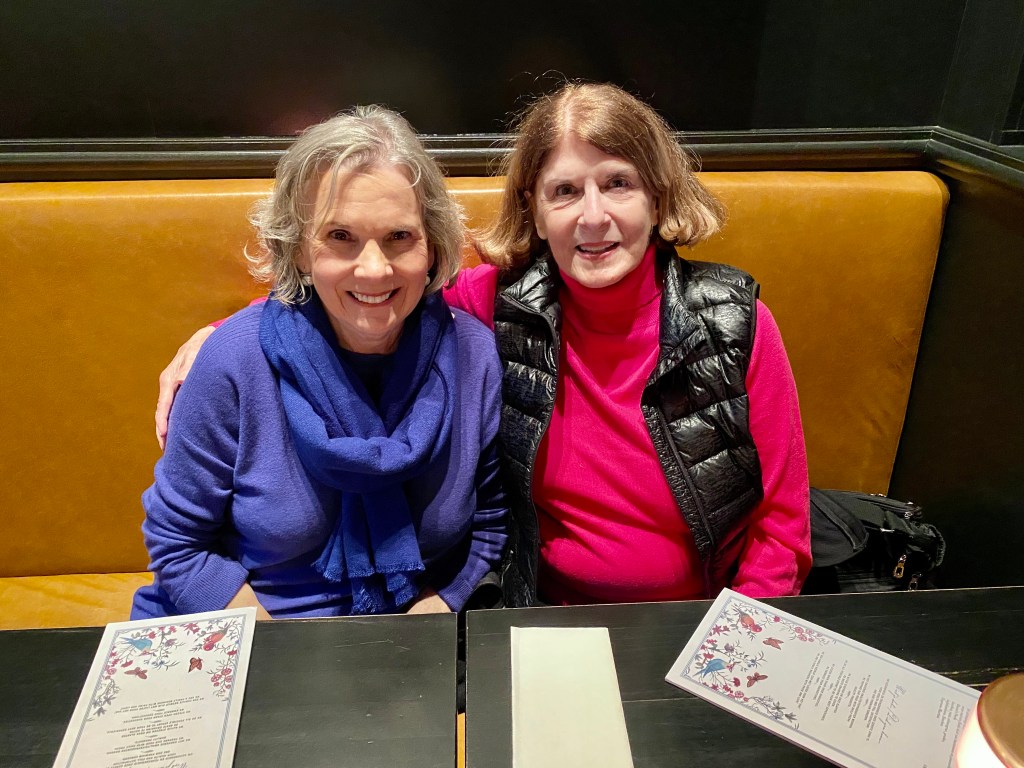
We had at least two excellent reasons to begin our southern Belgium expedition in Ghent. To travel with our friend, Chi Chi Hargraves (originally from Forest City now a long-time resident of DC), who was anxious to resume traveling after the restrictions of the pandemic were lifted. And to revisit the famous Ghent Altarpiece, the masterpiece that marked the transition from Middle Age to Renaissance art and the subject of intrigue and mystery for generations.
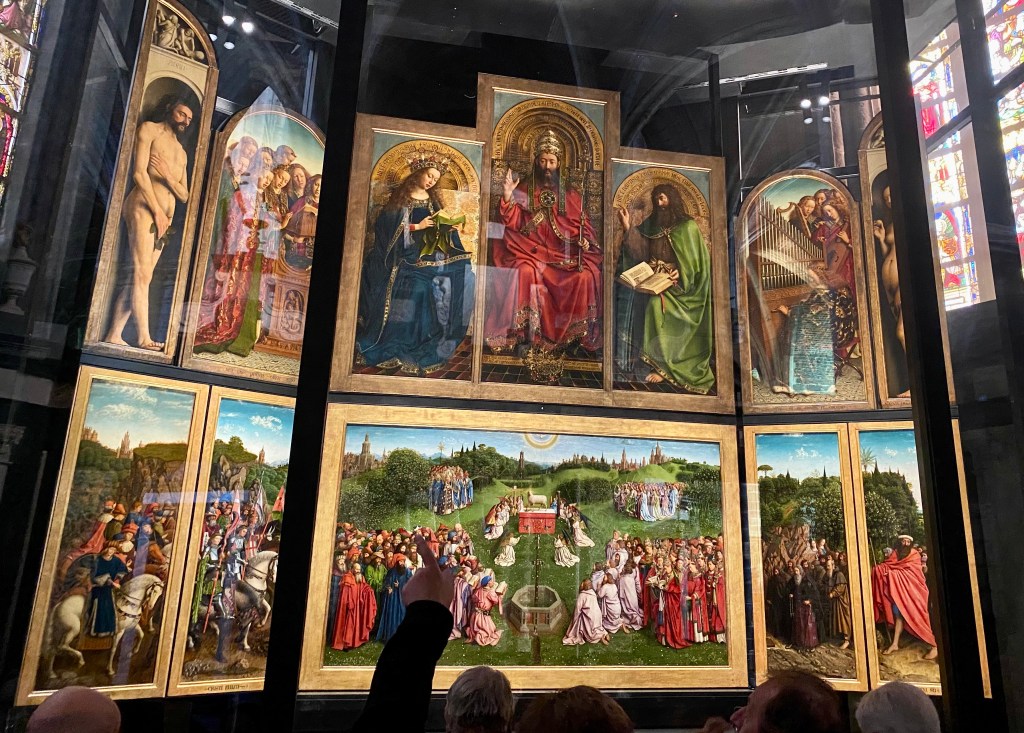
The Adoration of the Mystic Lamb, widely referred to as the Ghent Altarpiece, was commissioned by the town’s mayor for the “new” chapel being built adjacent to the choir of St. Bavo between 1410 & 1420. The treasure, which is considered the first great oil painting, is large (about 17 X 12 feet) and complex with 12 interior wooden panels of religious scenes. Eight panels are painted on both sides. All are executed in oil with remarkable attention to detail and introduce new ways of depicting light and shadow.
The masterpiece has been the victim of 13 crimes and 7 thefts over its lifetime of 590 years. One of its panels, known as “The Righteous Judges”, was stolen in 1934 and has never been found. In 1945, under the Allied program titled Monuments, Fine Arts, & Archives, the altarpiece was recovered from Germany and returned to its original home in St. Bavo Cathedral. “The Monuments Men” published in 2013 and the film of the same name memorialize the recapture. The mystery of the vanished 12th panel was integral to the plot of “The Omega Factor”, by Steve Berry, published in 2022. Berry’s story rekindled our interest in seeing the altarpiece again.
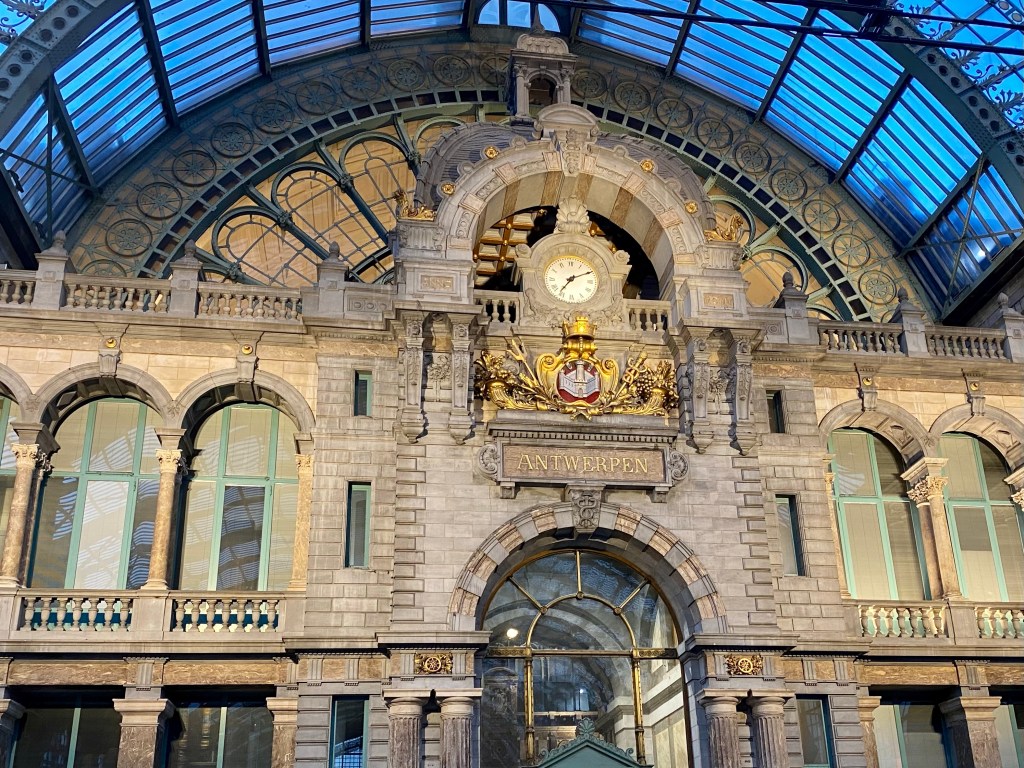
In Antwerp, in Flanders, the part of Belgium where Dutch is the primary language, our French was useless but, fortunately for us, English is commonly spoken too. Initially, we thought a day spent in the second largest city in Belgium would be enough, but when we examined the options more carefully, we knew it deserved a longer look.
Our hotel was in the heart of the historically rich and walkable city, so each time we went out, we passed by interesting monuments and notable places. We focused on seeing three museums, all within walking distance: the Peter Paul Rubens house; the Plantin-Moretus Museum; and the Red Star Line Museum.
Peter Paul Rubens, Antwerp’s favorite son, who is considered one of the most influential artists ever, was popular and celebrated in his own time. He was first of all a painter — but also a knight, diplomat, author, illustrator, art dealer, and avid collector. His own internationally famous art collection was the largest in the Netherlands.

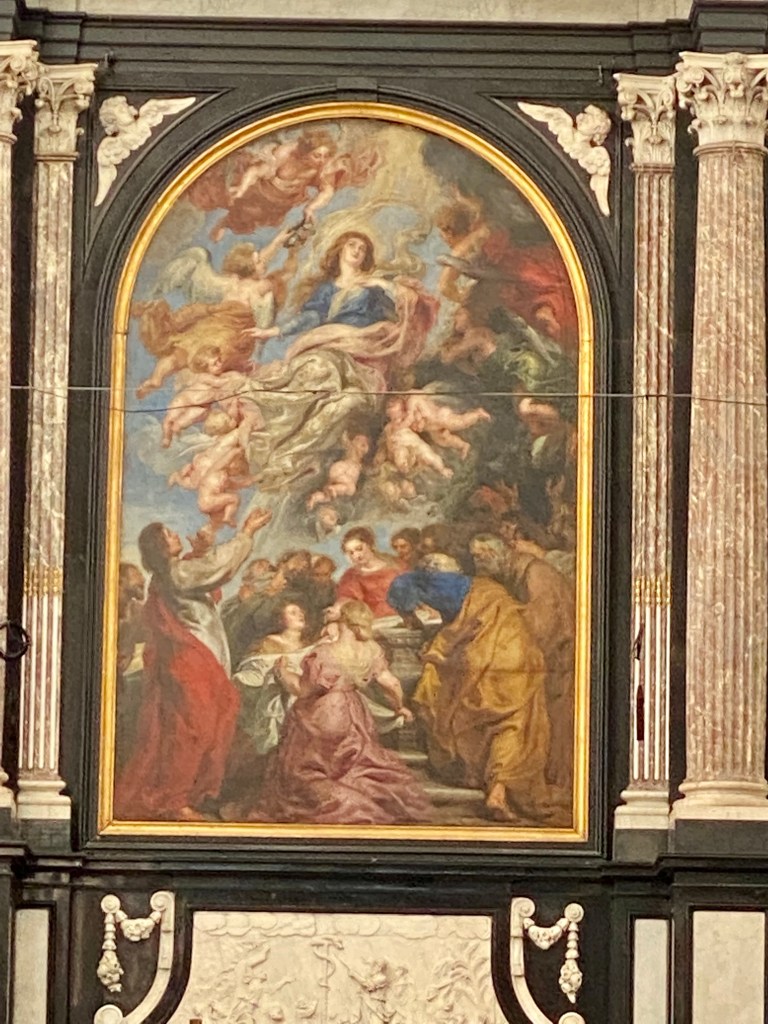
Rubens and his family lived in this beautiful Flemish style mansion for at least 30 years, until his death at age 63 in 1640. He painted many of his finest works in the studio he designed within and a collection of these are exhibited in the house including the spectacular The Annunciation. But the house is more than an art museum. You get the feeling you are walking in the great master’s footsteps and glimpsing a bit of the life of an aristocratic family in early 17th century Antwerp.
The Red Star Line was organized in Antwerp as a subsidiary of an American shipping company for the purpose of exporting oil to Europe then transporting emigrants and cargo on the return trip.

In his youth, Mr. Bressinck worked for years on the Belgenland, Red Star’s largest and most luxurious ship. Renie saved his dad’s passport. It shows that he made 70 crossings from New York to various European ports, e.g., Antwerp — New York; New York — Le Havre; Rotterdam — New York. We were thrilled to see his name listed among those of the crew members as we learned some of the history of the line and of the passengers it carried.
The unique Plantin-Moretus Museum, which contains 300 years of book printing, art, and family history, is the only museum in the world recognized as a UNESCO World Heritage site. It houses the one 16th century equipped printing and publishing works still in existence — the oldest printing presses in the world.

That might not seem all that interesting, but we were enthralled, not necessarily by the presses or the original lead type fonts, but by the antiquity and beauty of the treasures preserved and on display, especially a rare copy of a 36-line Gutenberg Bible (c.1450). Priceless works published by the Plantin Press include an album of plates commemorating the funeral of Emperor Charles V in 1559, a dictionary in Greek, Latin, French, and Flemish, and the Polyglot Bible – eight volumes in Hebrew, Latin, Greek, Syriac, and Aramaic.
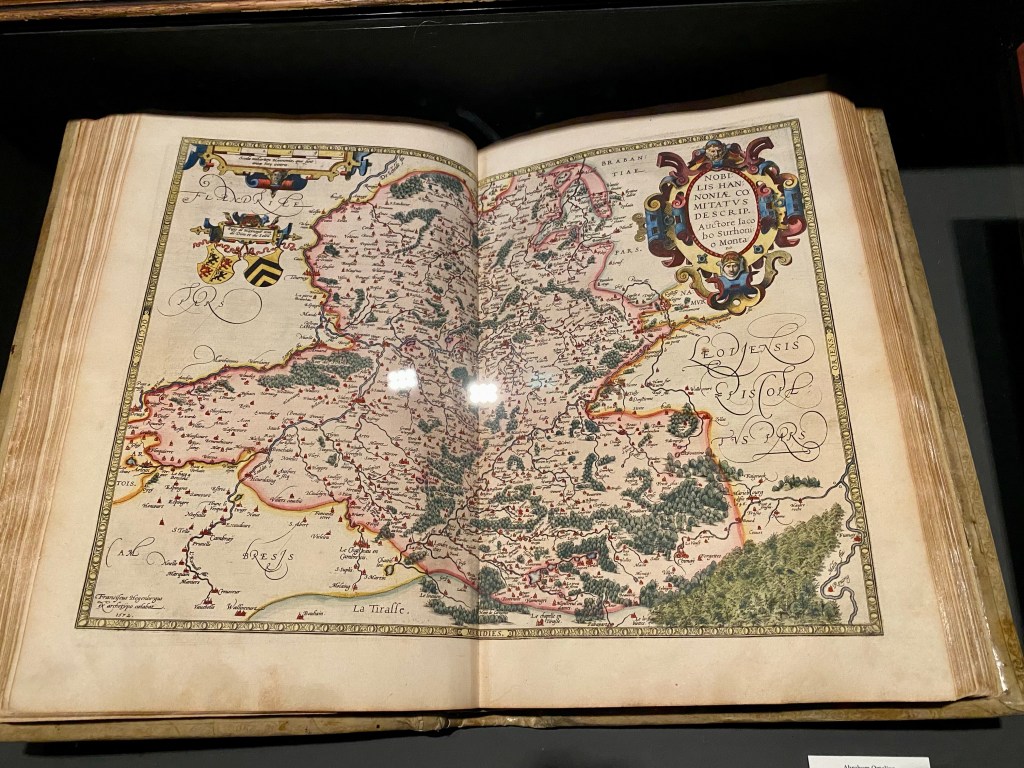
The first book Mr. Plantin printed was a manual on the education of young girls of good families, a work he must have consulted often as he and his wife reared their five daughters. We were impressed with his insistence that each of his daughters learn to read and write Greek and Latin. One was learned enough that she helped proofread her dad’s most famous project, the Polyglot Bible.

After driving south from Antwerp for an hour and a half, we arrived in Dinant, our home for the next week. Dinant is a picture-pretty town lying along the Meuse River and nestled against the rock cliffs topped by its citadel of stone. The three of us settled ourselves comfortably in the large house perched on the hill across the way. It came with a terrific view of the quiet town that is especially pretty at happy hour. Almost every evening, we opted to dine on simple meals at home where we could enjoy the special setting without the trials of negotiating traffic on dark and unfamiliar roads.
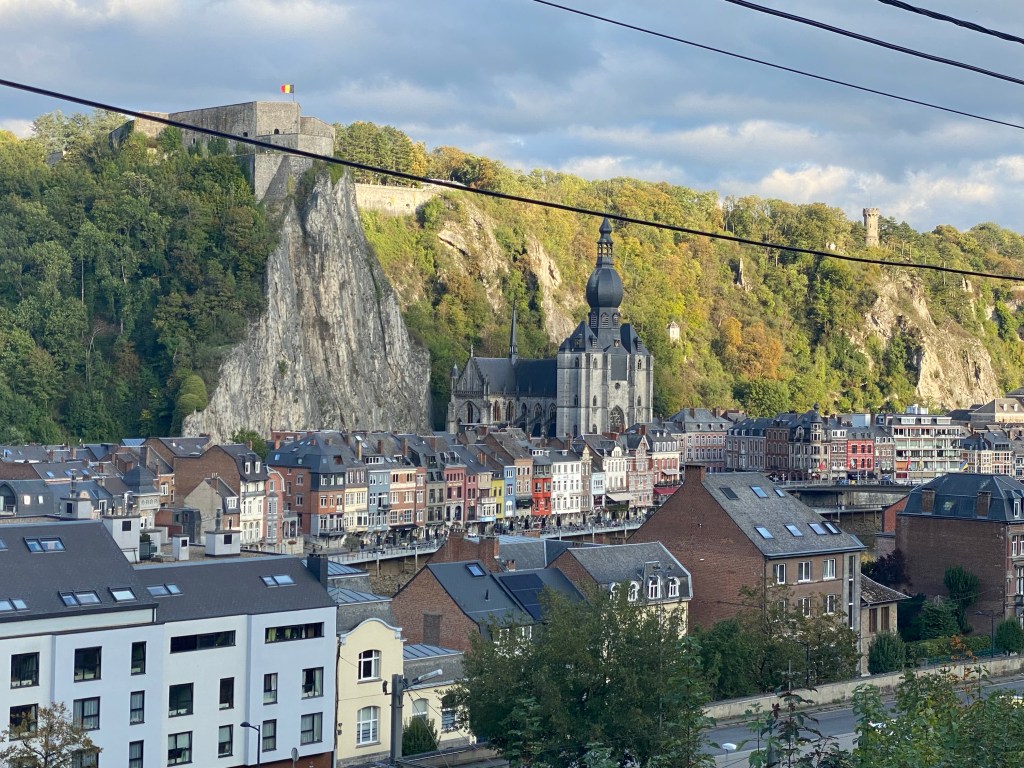
With its roots in Celtic and Roman times, Dinant was the birthplace of successful artists, politicians, and Adolphe Sax, who invented the saxophone in the 1800’s. It was our home base for exploring quaint villages and large towns including Leuven and Liege and also Aachen, Germany.

Leuven is not only home to the largest and oldest university in the Low Countries, the University of Leuven founded in 1495, but also to Stella Artois, Renie’s Belgian beer of choice in the US. We sipped our drinks on the plaza of the Old Market Square in front of the Town Hall that was completed in 1469 then embellished on its facade by the addition of 236 statues in the 19th century. Each statue represents a prominent local scholar, artist, or noble — a veritable history lesson.
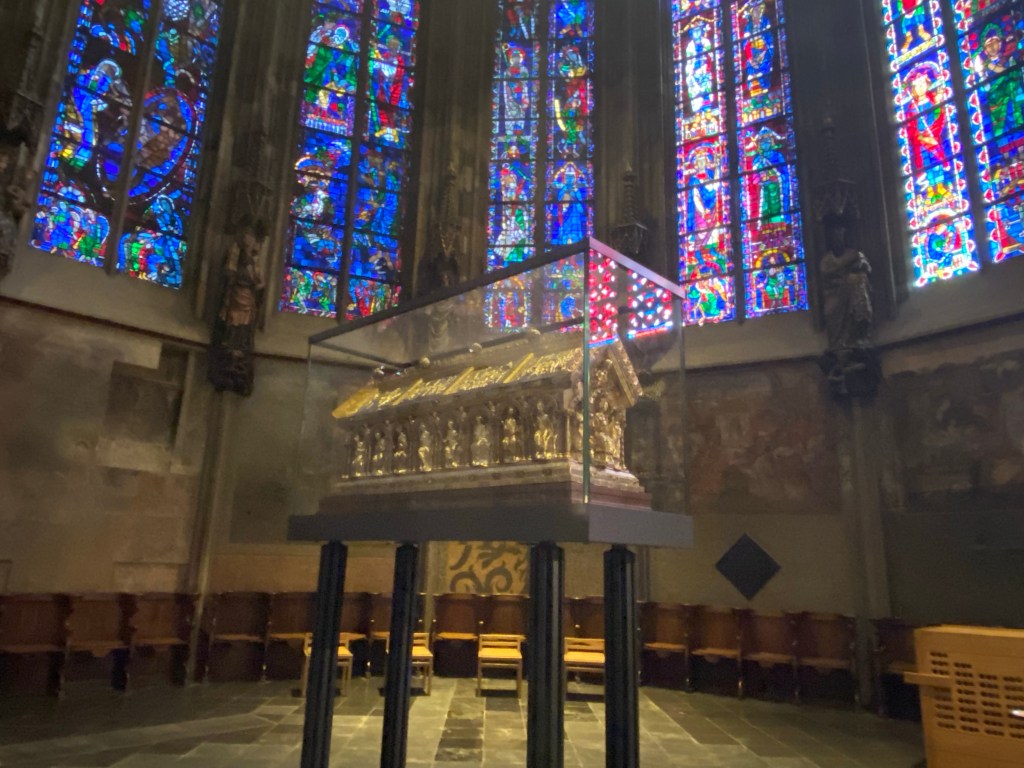
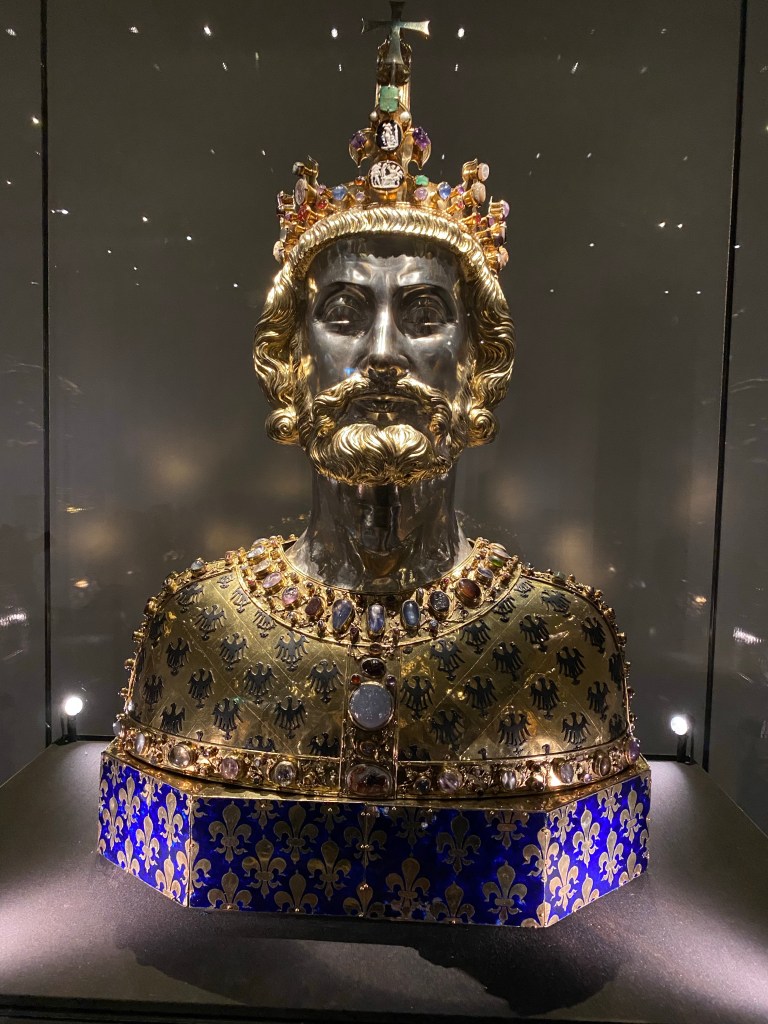
We stretched the geographical boundaries of our year in francophone countries to dash across the border of Belgium and Germany to the nearby town of Aachen — Charlemagne’s town. As King of the Franks from 768, the Lombards from 774, and the first Emperor of the Romans from 800, Charlemagne united most of Western and Central Europe through force and personality. His legacy of political, ecclesiastical, and education reforms changed the future of Europe and provided a foundation for later developing countries.

The heart of the magnificent Aachen Cathedral, the oldest cathedral in Northern Europe, is the Palatine Chapel built by Charlemagne as the Imperial Chapel, probably in the 790’s. The king installed a throne made of cream-colored marble in the chapel. It is plain without ornamentation, yet with much symbolism. The marble is now a brownish-yellow color due to staining from tar paper used to protect the chair when it was hidden during WWII. Charlemagne’s son was the first king crowned on the throne which later served as the coronation throne for at least 30 German kings during 600 years.
At the conclusion of a week of fun and exploration, we delivered Chi Chi to Brussels where she planned to stay several more days. We couldn’t leave, however, until we shared a meal of mussels and Belgian fries at Renie’s long-time-favorite restaurant on the Grand Place, Le Roi d’Espagne.
—Renie and Diane
 Travel in Le Troisième Âge
This travel narrative is a masterpiece. Scott
Get Outlook for iOShttps://aka.ms/o0ukef ________________________________
LikeLike
Beautiful photos and narrative! Do you ever rest? Thank you!
LikeLike
We love Belgium! Beth loves Stella Artois as well. Don loves mussels. We both love frites!! This was a walk down memory lane for us.
I might have recognized Chi Chi if she still had that bun on top of her head!!
Really enjoying the cultural parts of your texts!!
LikeLike
Oh my, the history, culture, beauty and nostalgia comes through in your informative narrative. and photography. Thank you for taking us along on your journey through these historically rich areas. We especially love seeing your smiling faces with friends and food.
LikeLike
<
div dir=”ltr”>I’m learning a lot from your wonderful travel reports! Thanks. BTW, Diane, you and ChiChi look great. Wh
LikeLike
love these! so fun!
LikeLike
Great blog! Nice to hear about Renie’s heritage! Safe travels and Happy Thanksgiving. Vicki
Sent from my iPhone
>
LikeLike
Great blog ! Lots of wonderful history. Thanks again, be safe.Vicki
LikeLike
Loved reading Renie’s background and seeing all of the wonderful art and places you visited. You are doing a great job educating and sharing your fabulous travels with us. Many thanks and happy Thanksgiving. Miss you.
LikeLike
Diane and Renie. Love to travel with you by way of these wonderful reports. Thank you so much for taking the time to share your adventures!
LikeLike